
How will you build on discussions in your classroom?
Debriefs
In order to create a classroom culture of student led discussion, students need to be able to have a debrief about the discussion they had and receive feedback. At the end of the discussion, students should assess themselves and the group. We think about the quality of the discussion and quantity of participants.
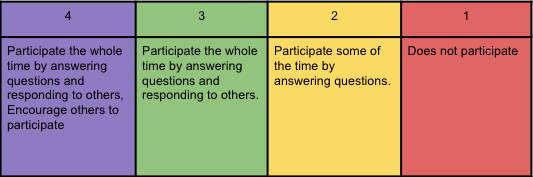
Before the discussion, we review our rubric. After our discussion, we have a debrief. I ask students to give the group a grade based on the rubric. Students defend the grade and share how they think the class can do better. I like to give my students something to think about:
- If the class receives a 2, how can we have an effective discussion?
- If it’s the same people participating, how can we know what everyone thinks?
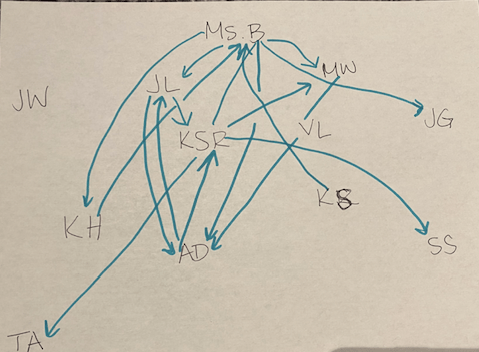
Students also need to think about how they did during discussions. We use a conversation map so students can reflect on their participation. I show my students the map above and they find their name. They look at how many lines are coming from their name to see how often they participated. Through the map, they can also see the quality of their participation. Are they only responding to the teacher or are they also responding to their classmates? I also provide the reminder that each week, there should be less lines coming from my name and that they should be conducting the bulk of the conversation. This self-assessment is helpful when I provide feedback for the discussions moving forward.
Feedback
Students also need feedback on how to improve discussion. Currently, I’m giving feedback on responding to classmates. I let my students know that we can’t always ONLY want to share our answer, we also have to respond to what someone else says. That is how discussion continues to flow. Based on feedback, my class is working on responding if you hear something confusing or incorrect:
- Ask questions
- Agree or disagree
- Guide that student to correctly understanding the topic
Understandably, some students may need prompts to help them jump into a conversation. I provide my students with prompts to allow them to join a conversation even when they are unsure of how to start. Below you will find prompts for students to enter math discussions.

This is another addition to the Series: Fostering Student Led Discussions. Come back next week for: GETTING UNCOMFORTABLE!
 inspire innovators